
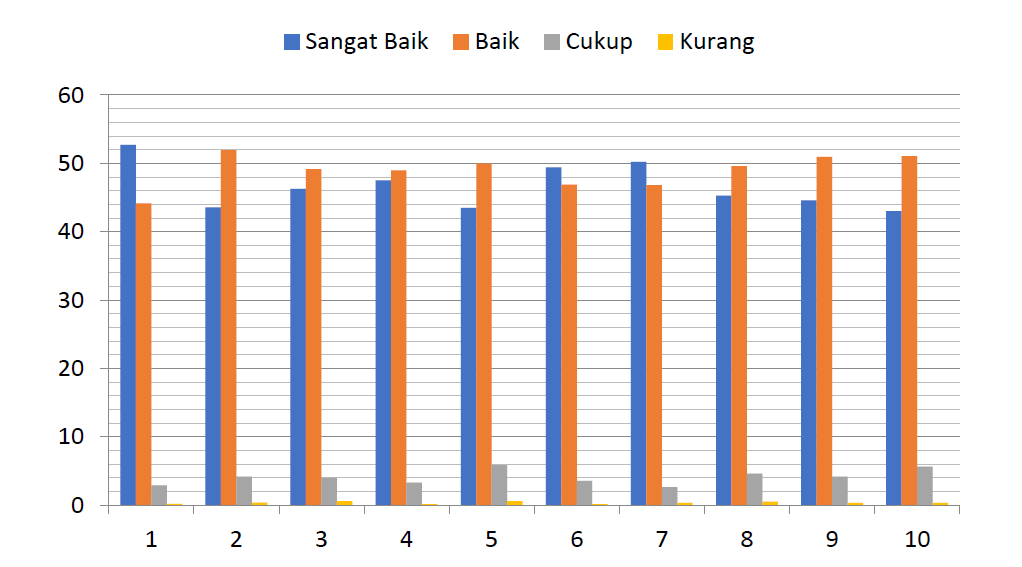
Aspect Description
1. Presentation of the course syllabus/contract at the beginning of the term (applicable only to lecturers during the first session)
2. Use of relevant and up-to-date reference books/literature
3. Alignment of the actual course delivery with the assigned credit (SKS) load
4. Alignment of the material presented with the course syllabus/contract
5. Course material that motivates students to further develop their knowledge
6. Provision of opportunities for students to ask questions and engage in discussion
7. The lecturer’s attitude, behavior, and appearance during the course sessions
8. Allocation of a realistic timeframe for the completion of assignments
9. Appropriate weighting of assignments, tests, and examinations in the final grade calculation
10. Provision of constructive feedback on student learning outcomes (assignments, examinations, quizzes, etc.)
ANALYSIS AND FOLLOW-UP
Analysis:
The lecturer’s role in the learning process is rated very highly, with 46.60% of responses falling into the “very good” category, followed by 48.94% as “good,” 4.09% as “fair,” and 0.36% as “poor.” However, the three aspects with the lowest “very good” ratings are:
1. Use of relevant and up-to-date reference books/literature (43.55%)
2. Course materials that motivate students to further develop their knowledge (43.51%)
3. Provision of constructive feedback on student learning outcomes (assignments, exams, quizzes, etc.) (43.00%)
Conversely, the three aspects with the highest “very good” ratings are:
1. Communication of the course syllabus/contract at the beginning of the term (applicable to lecturers during the first session) (52.71%)
2. Provision of opportunities for students to ask questions and engage in discussion (49.41%)
3. The lecturer’s attitude, behavior, and appearance during the delivery of the course (50.21%)
Follow-up actions:
To address the results of the analysis above, the following steps will be taken:
1. Communicating the course evaluation results to all lecturers in the Undergraduate Biomedical Engineering program, both through department meetings and individual discussions.
2. The Head of the Study Program (KPS) will encourage and motivate all faculty members to continuously improve their personal quality in conducting teaching and learning activities, specifically by providing constructive feedback on student learning outcomes.
3. The Head of the Study Program (KPS) will encourage all faculty members to utilize relevant and up-to-date reference books/literature.
4. The Study Program and all lecturers will review the practice of providing constructive feedback on student learning outcomes (assignments, exams, quizzes, etc.).